Trump Wanted To Cut Ed Department Into Irrelevancy. New Report Shows How He Did It
The Office of Inspector General of the U.S. Department of Education tried to assess the extent and impact of the Trump Administration’s initial layoffs and cuts in early 2025.

;)
Education news and commentary, delivered right to your inbox.
Sign up for The 74 newsletter.
Get stories like this delivered straight to your inbox. Sign up for The 74 Newsletter
The U.S. Department of Education may no longer be able to fully support students, it says in an internal report that lays bare the full extent of the Trump Administration’s first round of government cuts.
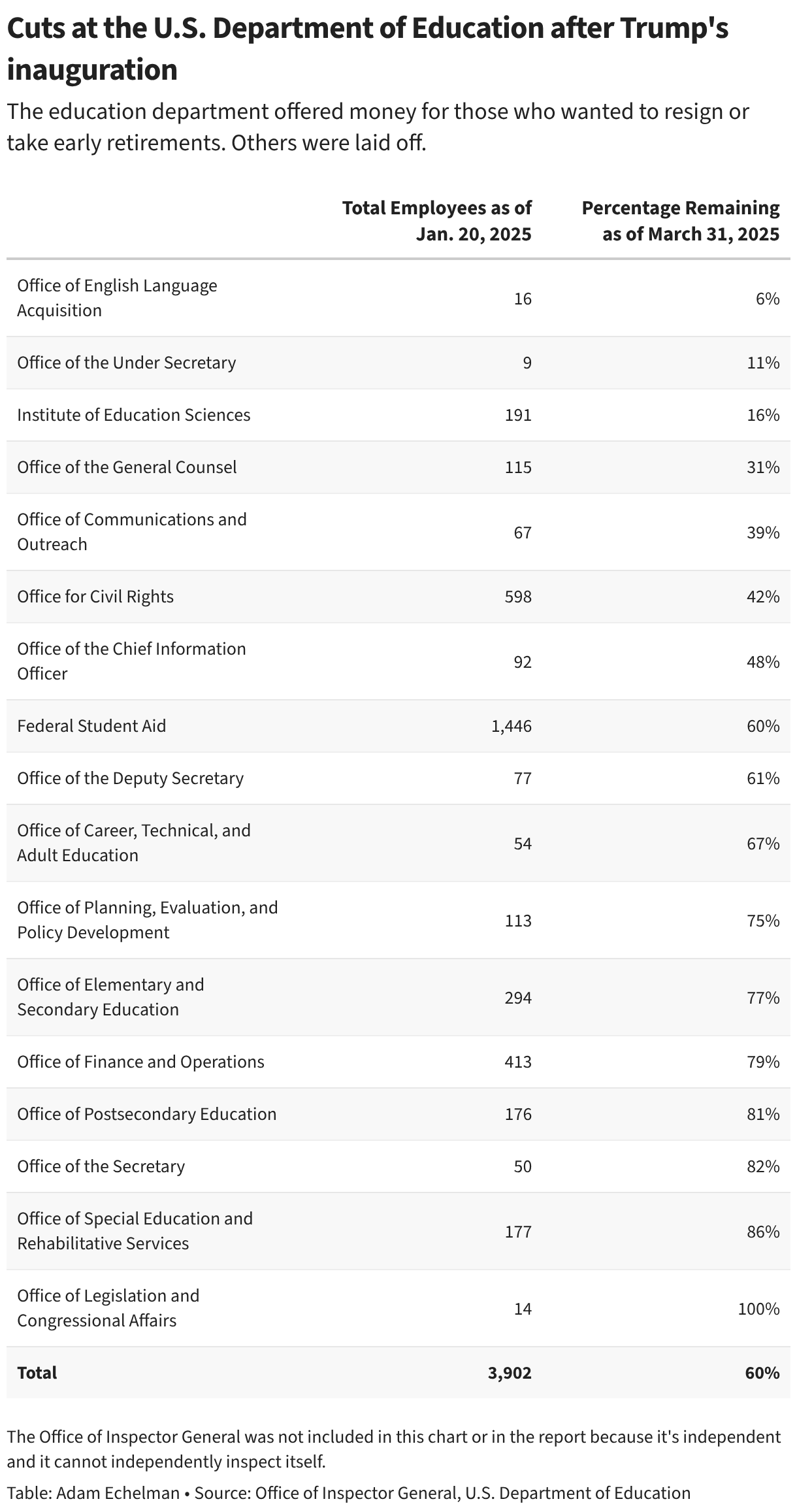
The department lost about 40% of its staff from the day Trump was inaugurated on Jan. 20, 2025 through March 31, 2025, but certain subdepartments were hit harder, according to the report released last week. The Office of English Language Acquisition, which served immigrant students, was gutted, leaving one employee, according to . The department also terminated contracts and grants totaling roughly $2 billion.
Although the report was internal, conducted by the education department’s Office of Inspector General, it is incomplete. Department staff did not comply with all the inspector general’s requests and cancelled interviews. As a result, the report says that many of its key findings are not definitive and that the total number of layoffs, the impact of those cuts, and the reasons for terminating certain contracts and grants remain unclear.
The report also says that because of the cuts, the education department may no longer be able to administer Congressionally appropriated dollars or oversee federal education law, including the distribution of financial aid, investigations and data analyses.
“According to the Department of Education’s own inspector general, the rapid elimination of nearly 1,600 staff, including those responsible for teacher training, student mental health programs, and legally required oversight functions, raises serious questions about whether the department can still meet its obligations to students,” said Kindra Britt, director of communications and strategy for . “These are not bureaucratic losses; they have real consequences for real kids.”
The report only includes cuts through March 31, 2025, and the education department has continued to cut staff and terminate grants and contracts since then. A number of grants have also been restored . The Trump Administration has slowly transferred many education services to other federal agencies, including the U.S. Department of Justice and the U.S. Treasury Department. This year, the sole remaining staff member supporting English language acquisition elsewhere in the department and the work was transferred to the Office of Elementary and Secondary Education. That office is now managed, in part, by the .
“The Department of Education is focused on returning education to the states while preserving critical funding and reducing unnecessary bureaucracy that can slow support to students and families,” wrote Kirsten Baesler, assistant secretary of the department’s elementary and secondary education office. “English Learners should never be treated as a siloed program, set aside as an afterthought.”
In a statement, Scott Roark, a public information officer with California Department of Education, said the state remains focused on helping students, regardless of the administration’s efforts to “disrupt services and safeguards” and to “impose a national ideology on local schools.” He said schools directly impacted by these disruptions should contact the state’s education department for help.
Is the U.S. Education Department more efficient?
Soon after his inauguration, Trump signed executive orders and directives which proposed ways to make government more efficient. The U.S. Education Department, spurred on by those orders, sent out offers to all federal employees saying they could resign and stay on payroll for a few months. Later, in March 2025, the department began laying off workers.
The cuts were uneven across the education department’s 17 offices, according to the Inspector General’s recent report: The Institute of Education Services, which conducts research, and the Office of the Under Secretary, which oversees many higher education programs, lost over 80% of their employees, much like the Office of English Language Acquisition. The 14 employees in the Office of Legislative and Congressional Affairs were untouched. The Office of Inspector General is an independent entity and did not review itself.
Whether those cuts have created any efficiencies is up for debate.
Sharon Bonney, the chief executive of , a national organization representing adult education programs, said she primarily interacts with the education department’s Office of Career, Technical, and Adult Education, which lost about 30% of its staff in the first few months of 2025, according to the report.
“I haven’t seen them miss a beat. I have seen more efficiencies,” said Bonney. “In the past I would send an email, it would take three weeks to respond to, and now, two hours later, I have a response.”
For Edgar Lampkin, the chief executive of the California Association for Bilingual Education, the effects have been “devastating.”
California still struggles to serve its more than 1 million English language learners, in bilingual education, and recent efforts to improve California’s bilingual education have received .
Lampkin’s association, along with the advocacy coalition , has long received federal grants, sometimes totaling as much as $1 million annually, to train bilingual teachers across the state. “Those grants are gone,” he said — and the Trump Administration won’t see the full impacts of its actions, he added. “The effects of education are normally 10 plus years ahead.”
This article was and was republished under the license.
Did you use this article in your work?
We’d love to hear how The 74’s reporting is helping educators, researchers, and policymakers.